
住吉さん(当時:中央大学M2)の研究成果が、Inorganic Chemistryに掲載されました。
電子状態インフォマティクスにより、高レベル放射性廃棄物の低減に重要なマイナーアクチノイド/ランタノイド選択性を示す、配位子設計指針を提案しました。
Inorganic Chemistry
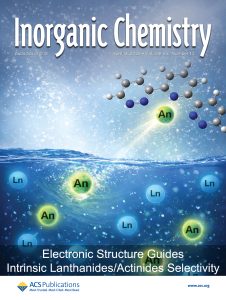
Electronic-Structure Informatics Guided Identification of Actinide/Lanthanide Selectivity Factors
Tsuyoshi Sumiyoshi, Nahoko Kuroki, Hirotoshi Mori*
Inorg. Chem. 65, 14, 7676–7683 (2026.4.13).
DOI: 10.1021/acs.inorgchem.5c05680
We report an interpretable electronic-structure informatics strategy for identifying ligand features that govern actinide/lanthanide (An/Ln) selectivity at the metal–ligand interaction level, a domain where limited experimental data and open-shell electronic complexity have hindered broad adoption of machine learning (ML) approaches. A systematically benchmarked DFT database of terpyridine-type ligands coordinated to Am3+, Cm3+, Eu3+, and Gd3+ enabled the construction of compact electronic descriptors that predict complex-formation free energies and An/Ln selectivity differences via Gaussian process regression. The resulting model achieves quantitative accuracy (mean absolute error; MAE = 17.5 kJ mol–1 for ΔGbind; 2.6 kJ mol–1 for ΔΔGAn–Ln) while preserving chemical interpretability. Shapley Additive exPlanations (SHAP) analysis reveals that metal ionization potentials and inner-site charge patterns cooperatively govern selectivity, consistent with established coordination principles and hard–soft matching trends. These insights yield actionable design rules: electron-deficient central azines paired with moderately π-accepting terminal donors preferentially enhance An binding relative to Ln. By explicitly positioning the model as a controlled aqueous-phase thermodynamic screening layer, this work provides a reproducible and mechanistically grounded ML framework for predicting intrinsic An/Ln selectivity factors. The resulting electronic design variables are consistent with reported experimental trends and provide a practical basis for future extraction-oriented ligand design.